
When a speaker takes the stage, the room is filled with an atmosphere of focus. It was their name that drew the crowds to this conference. The slides begin to complement their words and hundreds of eyes fixed on them try to memorize as much as possible.
Meanwhile, there is one person in the room looking in a completely different direction. She stands on the left side of the stage, and her gaze is fixed on a large, illuminated paper board. Or rather, on the drawings she is skillfully creating at that very moment.
What is she doing at this conference? Why do the world's largest corporations ask for her help? And what is all this supposed to achieve? I invite you to read on!
What is missing at conferences?
Many years ago, when the first business conferences appeared in our country, they met with great enthusiasm. After all, you could meet everyone in the industry in one place. Conversations over coffee fostered the exchange of views and building business contacts. Presentations helped keep up with the latest trends. Today this market has developed greatly. Speakers are aware that it is not enough to walk on stage and read their slides in a monotone. They are getting better and better, because the bar is being set higher and higher. Thanks to the popularity of conferences such as TED or TEDx (I myself have had the opportunity to appear at them three times – which you can see here), practically anyone can watch plenty of good talks without leaving home. And this raises the expectations of conference participants. Some even joke about this showmanship. However, it cannot be denied that today speakers sometimes speak so interestingly that you do not know whether to take notes, take photos, record everything on your phone, or immerse yourself in their words. And usually at least a few of them speak, so it is hard to remember this huge amount of information. And there is one more problem. Conferences serve networking, but not everyone feels comfortable starting conversations with strangers (for example, shy or introverted people). This is where the person mentioned earlier, standing somewhere off to the side of the stage, comes in. This person is a graphic recorder, that is, a person who creates a visual record. What does she do?Using drawings understandable to everyone and essential, economical text, she captures each of the talks, supporting the memorization of the most important elements.
It looks, for example, like this: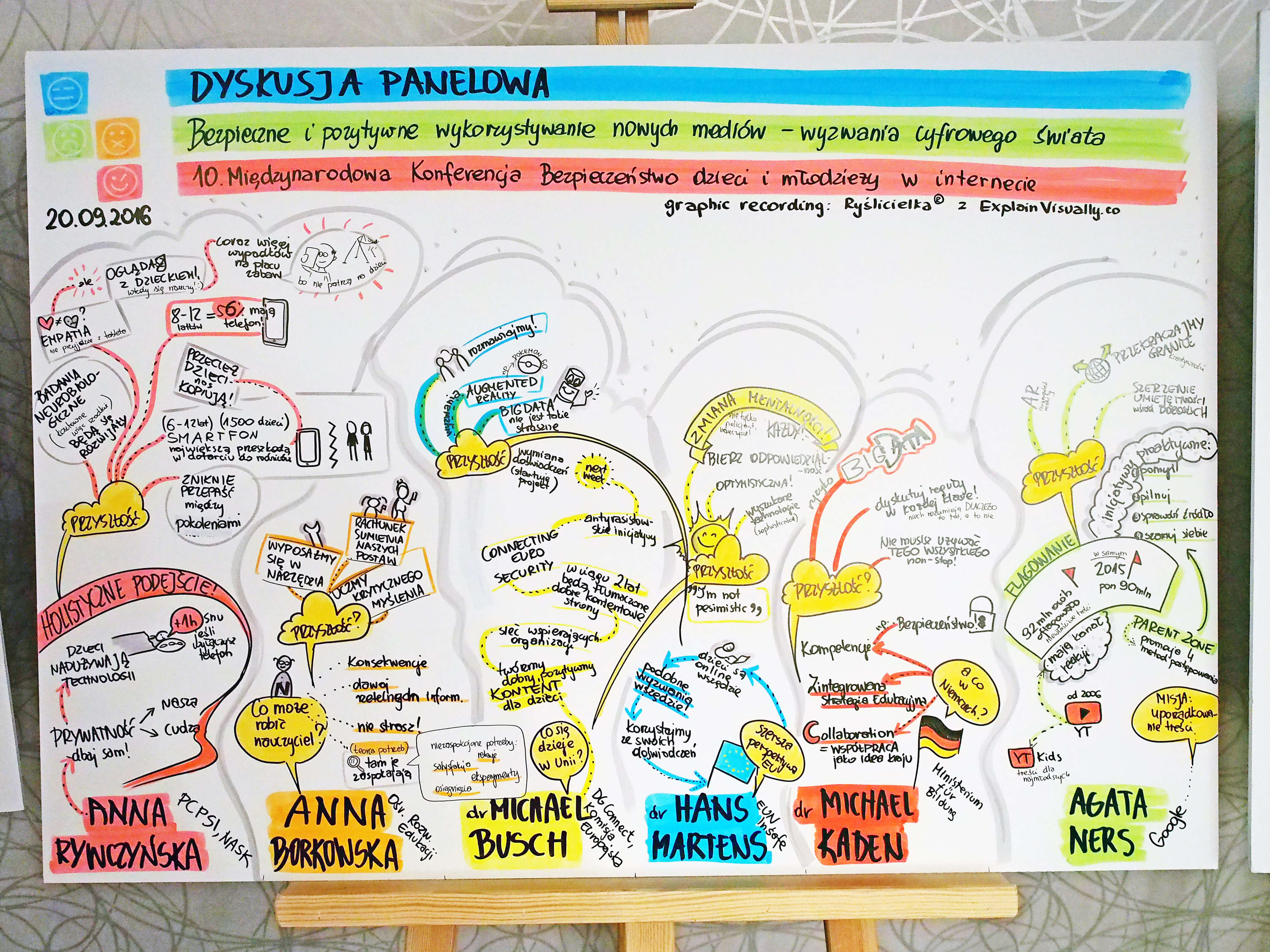 When conference participants know that the speakers' talks are being recorded, they listen more willingly (they no longer have to stand in an unpleasant mental split between note-taking and listening ;P). As a result, they remember the talks themselves better, and consequently – the entire conference. What is more: if they have the graphic recorder within sight, they can also glance at the drawings being created on an ongoing basis, because they are a visual summary of what the speaker is saying. Thanks to this, the knowledge becomes even more fixed in their memory.
What is it called?
In English, this type of service is most often called graphic recording. However, it takes on other creative names such as scribing, graphic harvesting, graphic facilitation (although I make an important distinction between the service of graphic recording and graphic facilitation, which I wrote about on my blog here). Interestingly: in the USA this service is often named with the prefix graphic (e.g. graphic recording, graphic harvesting, graphic facilitation etc.) while in Great Britain the word visual is rather used (analogously visual recording, visual harvesting, visual facilitation etc.). As you can see, naming dilemmas occur in every language – whether in English or Polish. In Poland, multiple terms are also used to describe the same thing. A person who does graphic recording is, for example: graphic facilitator, visual scribe, visual translator, conference illustrator, thought stylist, mind draftsman (!) or rysliciel (although as we know from here – there is only one Rysliciel® ;P). And the service that a graphic recorder performs is: graphic facilitation, (large-format) visual record, graphic record, thought record, draw-writing etc. The names never end! ?Graphic Recording at a conference
So what does the use of Graphic Recording at a conference look like? During the break, participants go out to drink coffee and tea and have a bite to eat. Right next to the catering are the drawn notes from the talks, eagerly photographed by the participants. They also serve as a natural pretext for starting a conversation, helping to break the ice. It is easier to start a conversation when you have a common topic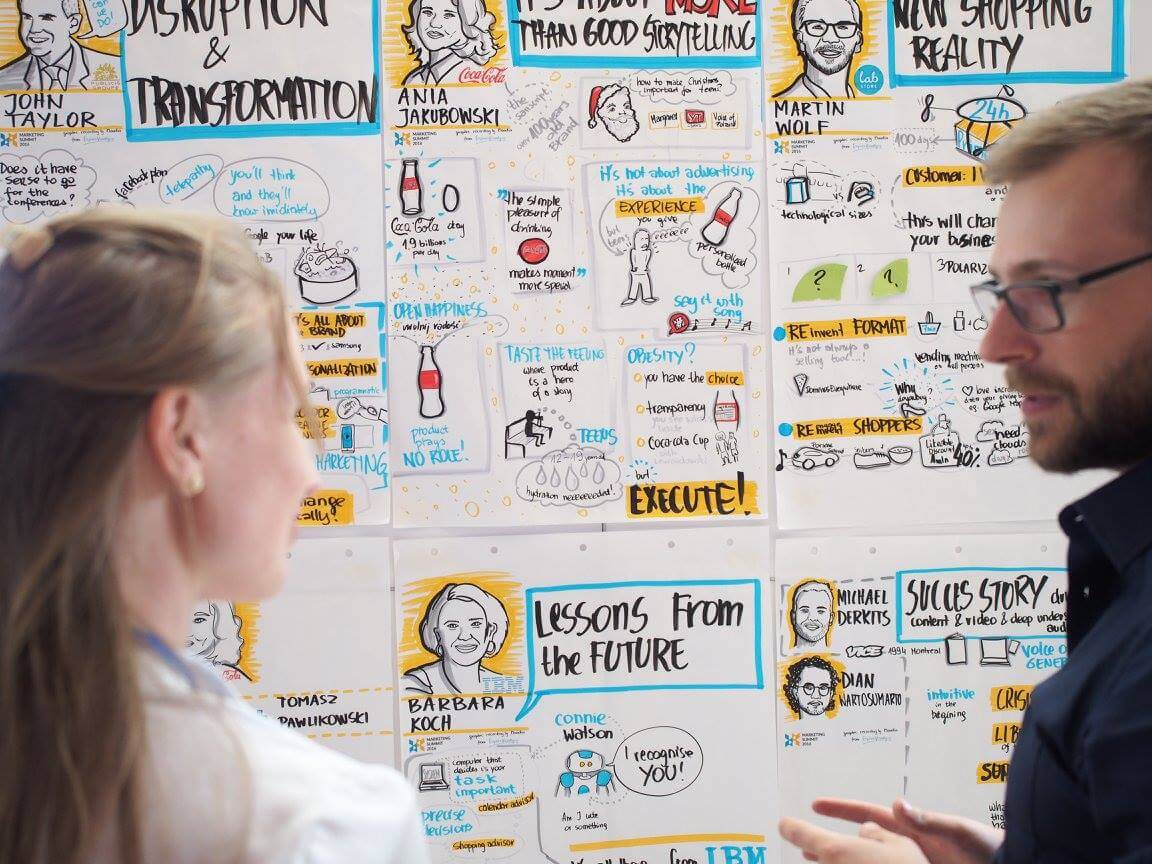 Speakers also capture the drawings, which are a very surprising souvenir for them. They often then share the boards on their LinkedIn and Facebook profiles and cannot get over the fact that the board contains exactly what they talked about during their talk.
GR shared by Łukasz Kosuniak, Marketing Manager of Samsung and author of the blog businessmarketer.pl
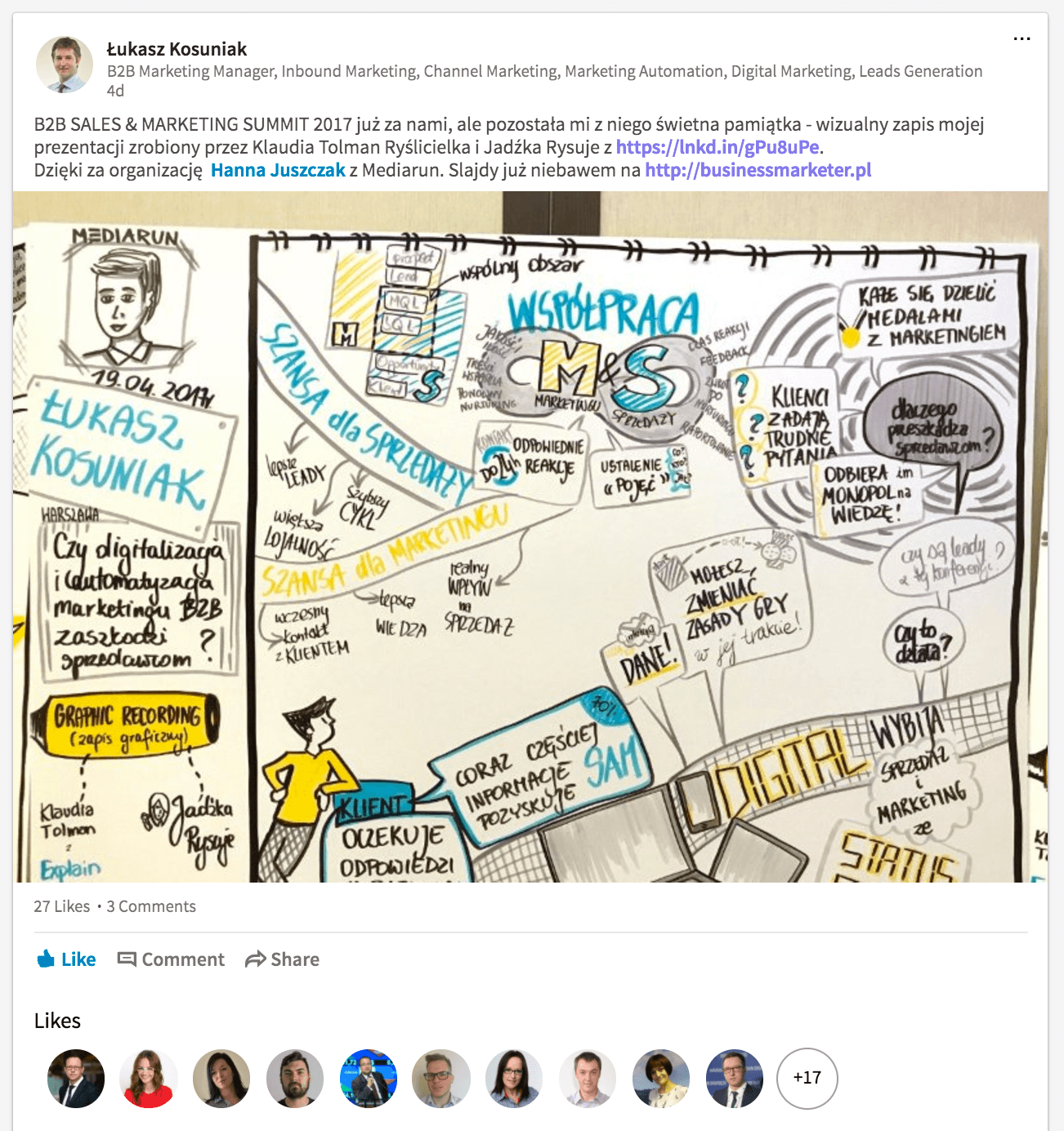 The advantage of Graphic Recording / visual recording is creating the image on one board. Thanks to this, we get the so-called big picture, that is, the full picture of the talk (or even the conference). Unlike a sequence of a dozen or several dozen slides, it is easy to grasp the full picture of the topic being discussed right away.
When the conference ends, participants receive high-quality photos of the boards. They have summaries of each talk at hand and within a dozen or so seconds can recall their content.
The advantage of Graphic Recording / visual recording is creating the image on one board. Thanks to this, we get the so-called big picture, that is, the full picture of the talk (or even the conference). Unlike a sequence of a dozen or several dozen slides, it is easy to grasp the full picture of the topic being discussed right away.
When the conference ends, participants receive high-quality photos of the boards. They have summaries of each talk at hand and within a dozen or so seconds can recall their content.
A brief history of Graphic Recording
It is hard to point unequivocally to when this drawing during events was born. David Sibbet, called by the community of the International Forum of Visual Practitioners (to which I belong) the Father (or maybe even Grandfather!) of visual practice, claims that the first graphic facilitations took place in the United States back in the 1970s.Even then it was obvious that groups work much better, think much more productively, and remember much more when they have the opportunity to process information visually and textually at the same time.
Along with the development of the industry, the possibilities of GR are also growing. Here with Natalia Klonowska and Ola Krawczyk against the background of our works during the New Trends in Tourism 2017 conference ?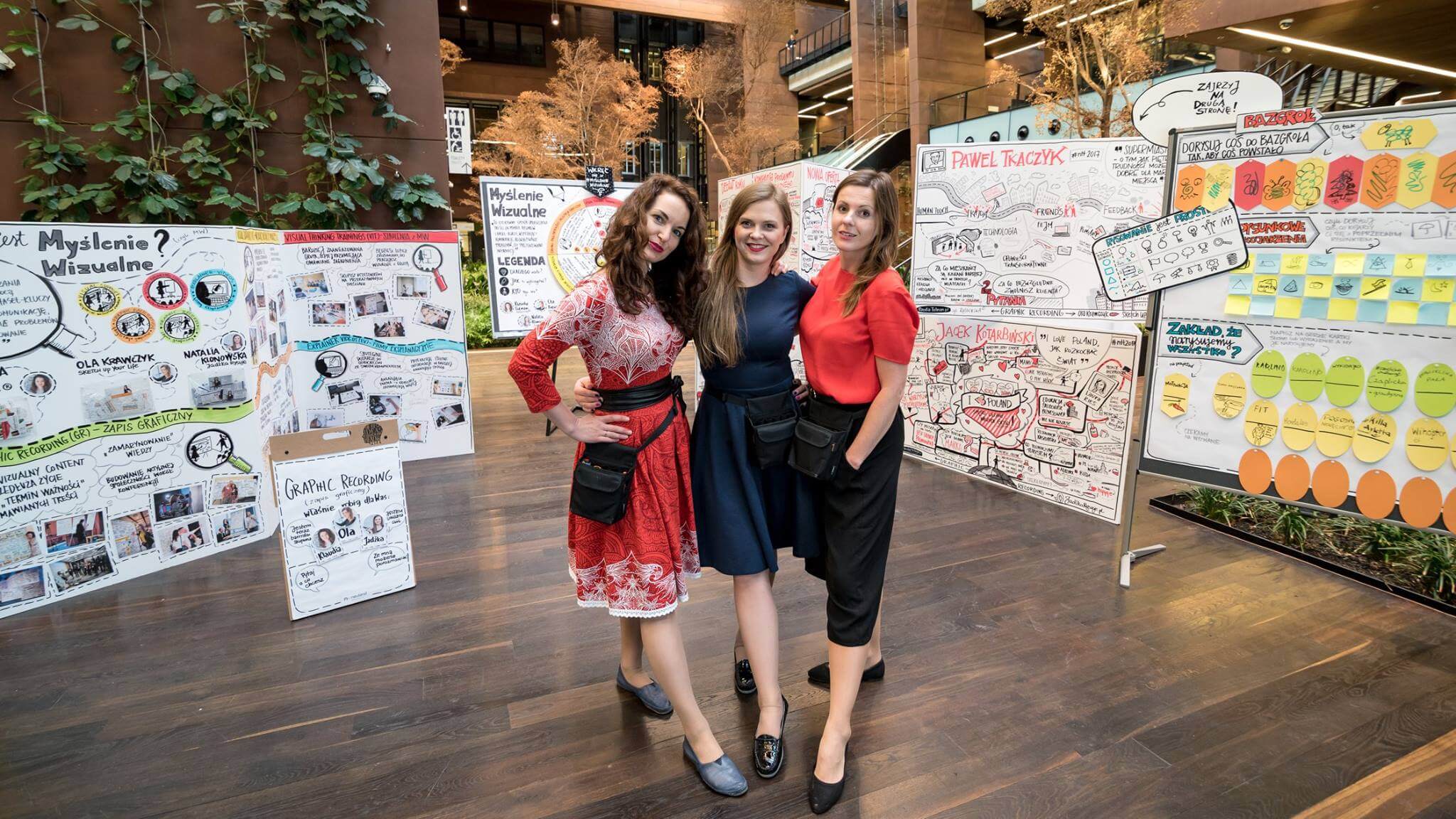 For several years in Poland we have been observing a real boom in these services. In addition to open conferences attended by dozens or hundreds of people, Graphic Recording is also commissioned by companies for their internal needs.
I myself (and I have been involved in GR since 2013) have done it for companies such as Google, PKN Orlen, IKEA, PepsiCo, DHL, Danone, Hilti, Bank BPH and Aviva. My colleagues in the profession (professional Polish scribes can be counted on the fingers of one, at most two hands) also serve many well-known brands.
Although in Poland visual support has been popular only for a few years, they have already written about us in:
For several years in Poland we have been observing a real boom in these services. In addition to open conferences attended by dozens or hundreds of people, Graphic Recording is also commissioned by companies for their internal needs.
I myself (and I have been involved in GR since 2013) have done it for companies such as Google, PKN Orlen, IKEA, PepsiCo, DHL, Danone, Hilti, Bank BPH and Aviva. My colleagues in the profession (professional Polish scribes can be counted on the fingers of one, at most two hands) also serve many well-known brands.
Although in Poland visual support has been popular only for a few years, they have already written about us in:
- INN: Poland http://innpoland.pl/125439,nie-umiesz-rysowac-swietnie-zostan-graphic-recorderem
- NaTemat http://natemat.pl/200601,zasypiasz-na-nudnym-szkoleniu-jest-nowy-trend-dzieki-tym-rysuneczkom-zapamietasz-wszystko
- and also on the Aude company blog: http://blog.aude.pl/blog/2015/06/01/ryslenie-czyli-myslenie-symbolami/
Graphic facilitation during key meetings
I have already mentioned that there is an important difference between graphic recording and graphic facilitation of groups (I recommend the article available here in Project 30:30). Why do companies use graphic facilitation? During strategic and project meetings, a few problems often come back like a refrain.The first of them is low engagement.
Not always are all participants willing to take active part in meetings. Sometimes because they do not see the point in it, often it also results from fatigue. A good agenda and a dynamic host help to go through all the points efficiently. A graphic facilitator can be a good support for the meeting. He or she impartially records all statements, thanks to which employees feel heard, and this encourages them to say more. The meeting gains in productivity. Looking at the graphic record, participants see what has already been discussed and where the discussion is heading. Additionally, this helps awaken the team's creativity, because they look at the topic from a new, visual side.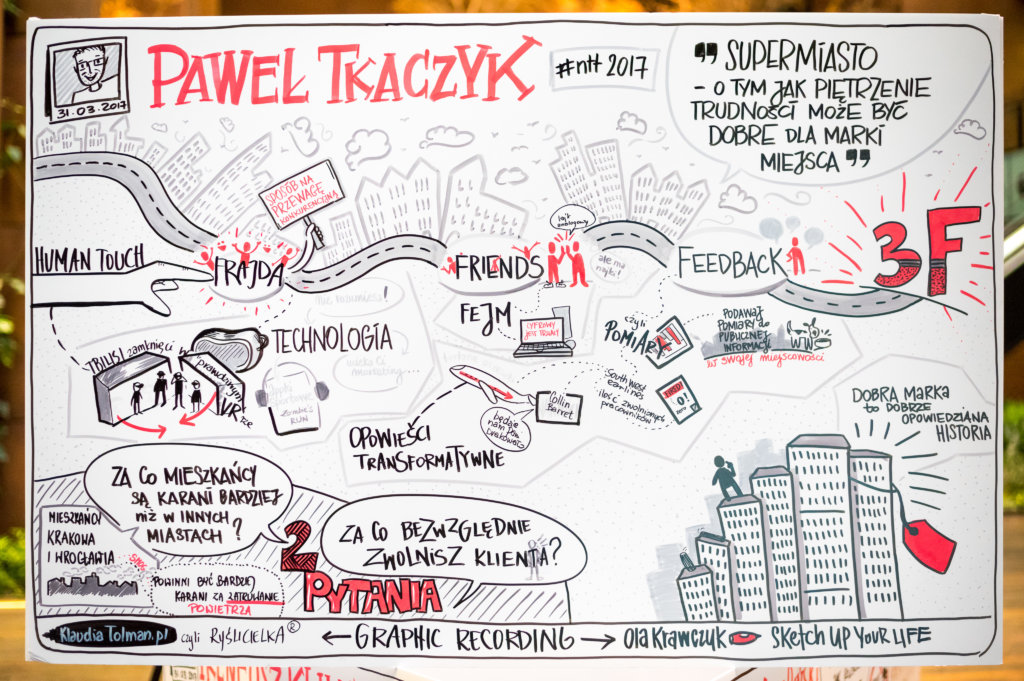
The second is a lack of understanding.
The same words often stand for different meanings. For the Finance Director, project success is something different than for the Marketing Director. Each of us looks through the prism of our position and the goals associated with it. Capturing the content by a visual facilitator and translating it into visual metaphors helps to clearly show all the perspectives on a given topic. Visualization additionally facilitates understanding – because the image already symbolizes a specific interpretation and direction of thinking. If we symbolize the project's success on the board with a $ sign, it will mean financial success. The marketing director, however, may then ask to add clasped hands, representing new customers. This may in turn lead to further discussion in the group led by the facilitator: for example, the group may say: no, we do not mean two hands, but a gesture of a dozen or so hands that warm up before a fight and placed one on top of another, preparing to chant a motivating slogan... This will allow the group to realize that it is these dozen or so people together striving for success in financial form.The graphic recorder organizes and summarizes the entire discussion on a given topic, thanks to which the Team gains a full picture of the situation. This allows them to make the best possible decision regarding strategy, product or communication.
Sometimes he or she also asks the participants themselves to draw something. Thanks to this, their engagement increases significantly, and through the unusual form of communication the atmosphere warms up.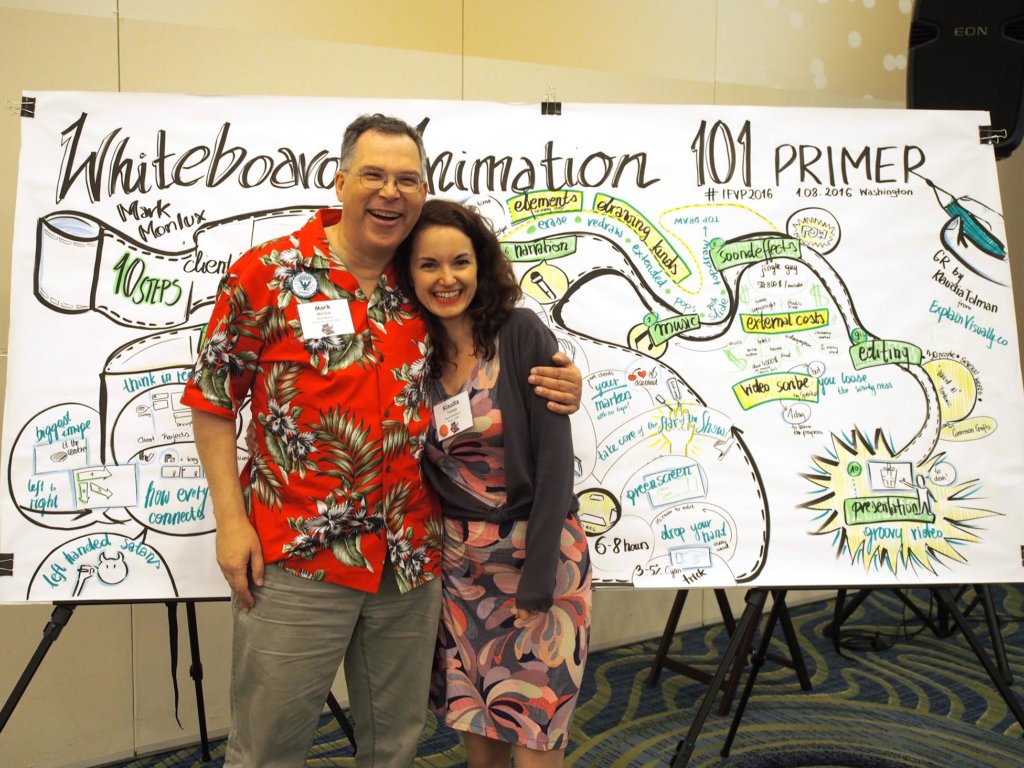
Is Graphic Recording for everyone?
Of course, visual translators are not invited to every meeting. It would be cost-ineffective and would cause difficulties in matching dates with the busy schedules of Graphic Recorders. They usually appear at key meetings, where the decisions made may have far-reaching consequences for the company. Then the visual record created during the meeting is often photographed and sent to employees. It serves as a summary of the most important points regarding the new strategy or product. And companies, once they experience creative and productive work, are often very willing to experiment further and use the work already done by the visual translator: one of my Clients used photos of the completed boards and made a wall calendar from them, a gift for every employee. The drawings made (of course, as long as the contract with the graphic recorder regulates it) can also be used to make various gadgets for employees or Clients, such as printed mugs, notebooks, fridge magnets or pins or mouse pads.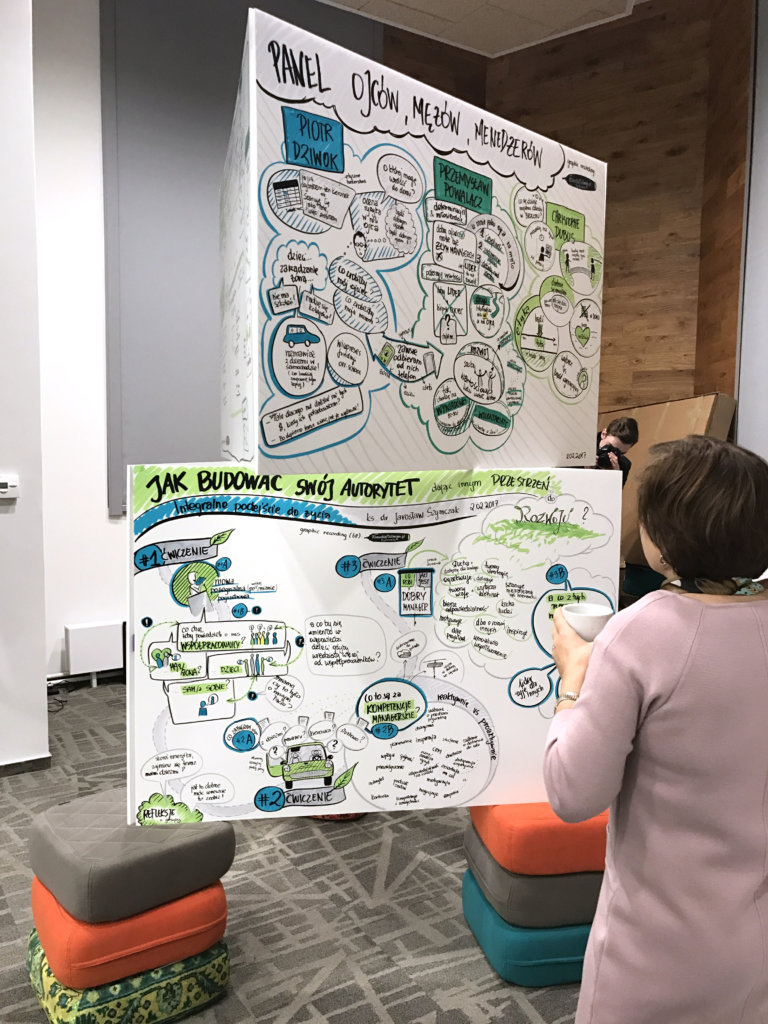
Summary
There are many possibilities for using Graphic Recording – both at conferences and during meetings. The movement itself has been evolving for over 40 years and its popularity keeps growing. This is especially visible today, when every day we have to process a huge amount of information and have less and less time. Professionally made drawings help us grasp the whole message faster and add a bit of relaxing "freshness" to serious topics. And drawings can be used in many ways. Graphic Recorders are usually very creative, so new ideas are often born during conversations with clients. That is why you never know what the next drawing will bring. And that is the whole charm of Graphic Recording! If the topic has caught your interest and you would be interested in using Graphic Recording in your organization, let us know at kontakt@klaudiatolman.pl ?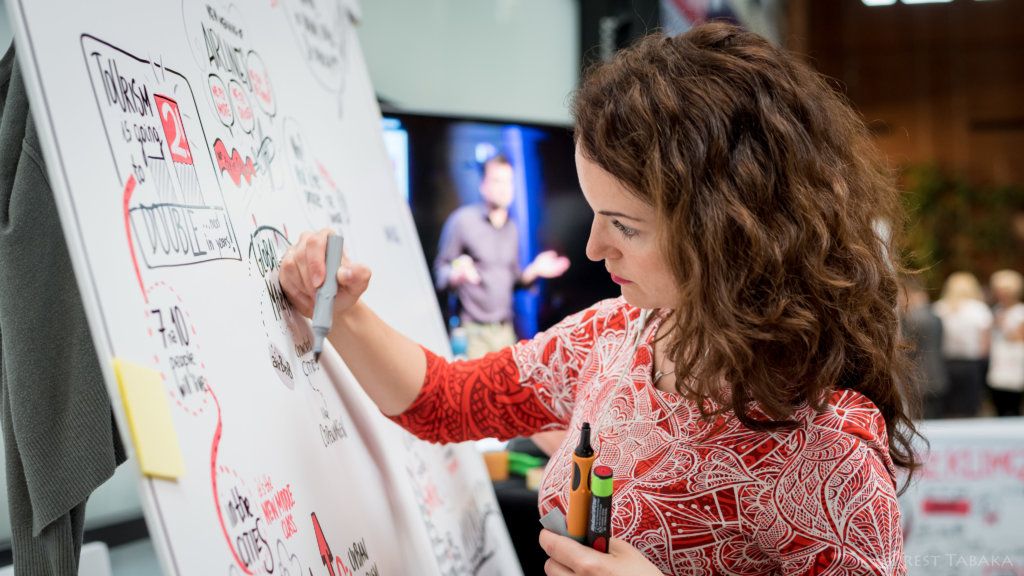 PS: Many thanks to Maciek Budkowski, working with me at ExplainVisually, for co-creating this article ?


