As Adobe has announced, by the end of 2020 the company will end technical support for Flash.
For this reason, Gemius decided to check how the share of page views on Polish websites generated by browsers not using this technology has changed over the past five years.
Two-thirds of views without Flash
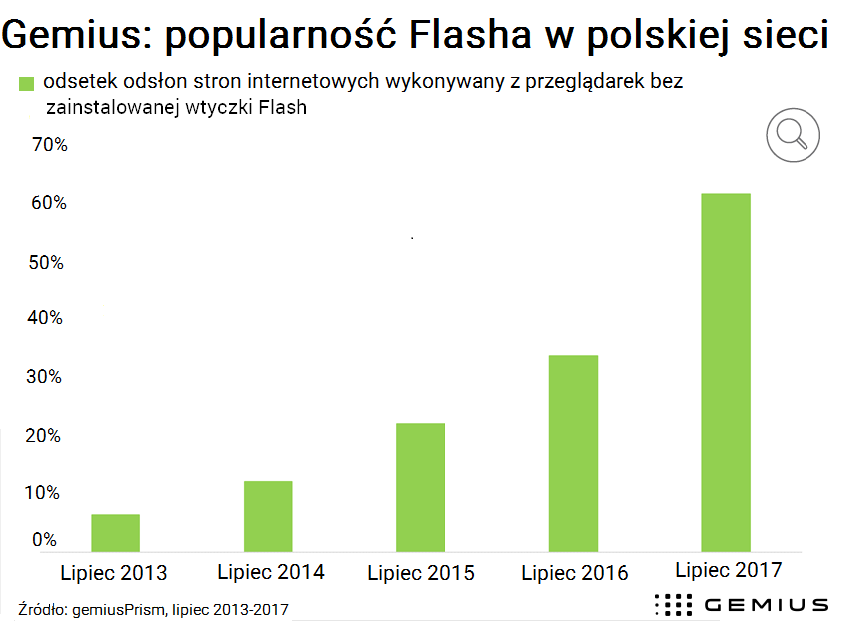
The data show that in internet practice there is a gradual but decisive move away from this technology. Over the past five years, the number of views of Polish websites generated by browsers without Flash rose from 6.4 percent in July 2013 to 61.5 percent in July 2017 (source: gemiusPrism).
─ Since the introduction of HTML5 and since Apple clearly said seven years ago through Steve Jobs that it would not support Flash technology, not least because of security or its energy consumption, Flash slowly but inexorably began to lose users ─ comments
Krzysztof Majkowski of Gemius. ─ In the meantime, Apple's share grew, and the iPhone became one of the most popular smartphones. Flash was still alive, and rumors of its imminent departure were rather exaggerated. Looking at it from the perspective of those seven years, however, the usability of the Flash plug-in is indeed declining, and even taking only that into account, it seems every larger site should be prepared to introduce HTML5 or other solutions for displaying video formats ─ adds
Majkowski.
Flash is losing ground faster and faster
The percentage of views made from browsers without Flash is increasing more and more clearly every year. A large jump was recorded over the past twelve months. In July 2016 it was only one-third of views; a year later it was already nearly two-thirds.
─ From Adobe's perspective, it is simply a product that is not very profitable to maintain, not least because of the need for continuous work on its security. Over time it became a millstone around its neck, and its profitability declined. It is an increasingly old technology whose maintenance involves costs, and there are now various mature alternatives: HTML5, WebGL or WebAssembly. They are either easier to use, or more efficient, more effective, or they work on more platforms and are therefore more cost-effective to implement. ─ Adobe was also not helped by Apple's decision to disable Flash by default in Safari. Of course, that is only part of the market, but it is one that the whole industry watches. Another blow is also Google's moves, as it imposes more and more restrictions on the use of Flash in Google Chrome. Mozilla has similar plans ─ comments the
expert.
Gemius analyzed data from 2013–2017 collected among Polish internet users using desktop computers and laptops as well as mobile devices.


