
In Poland, the Instagram app draws up to ten times more women than men to their screens.
In August, 2.1 million Polish female internet users used the Instagram mobile app, which accounts for 72 percent of all users of this app (3 million). The average daily reach of the Instagram app was nearly 1.4 million for women and only 225,000 for men. ─ From a business perspective, and more specifically looking at monetization opportunities, the fact that the app is so strongly female is undoubtedly a big asset, because a significant portion of advertising campaigns are aimed precisely at women, and reaching female target groups is important for many brands ─ comments Marta Wiercińska, expert at Gemius.
Over the course of a month, one can notice days when the app was used by as many as ten times more women than men. This situation occurred on August 18, 20, and 30.
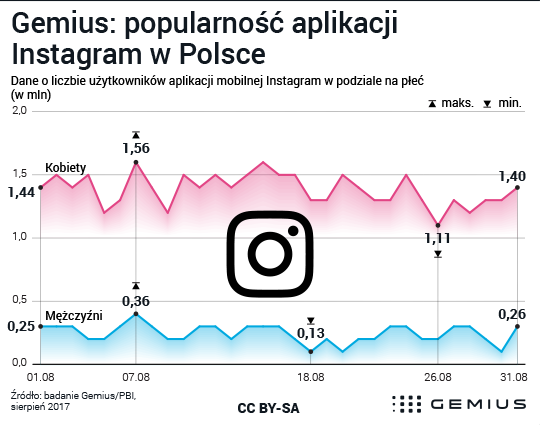 The highest number of users of both sexes was recorded on Monday, August 7 (1.6 million women, 361,000 men). That day, the disproportion between women and men clearly decreased — there were about four times more women than men (source: Gemius/PBI). ─ Lifestyle subject matter generally attracts women much more than men, regardless of the type of medium. This is the case in television, the press, and also on the internet. Taking this fact into account, it is not surprising that women reign in the Instagram app. After all, women are much more willing to share their emotions and feelings and love viewing beautiful photos, and the Instagram app fits precisely these needs.
Women use social apps very actively. Instagram is not the only one dominated by the fairer sex. In August, more women also used the Facebook app and Snapchat. By contrast, Twitter is used by more men ─ adds Wiercińska.
Gemius analyzed data from August 2017 collected among Polish internet users aged 7–75.
The highest number of users of both sexes was recorded on Monday, August 7 (1.6 million women, 361,000 men). That day, the disproportion between women and men clearly decreased — there were about four times more women than men (source: Gemius/PBI). ─ Lifestyle subject matter generally attracts women much more than men, regardless of the type of medium. This is the case in television, the press, and also on the internet. Taking this fact into account, it is not surprising that women reign in the Instagram app. After all, women are much more willing to share their emotions and feelings and love viewing beautiful photos, and the Instagram app fits precisely these needs.
Women use social apps very actively. Instagram is not the only one dominated by the fairer sex. In August, more women also used the Facebook app and Snapchat. By contrast, Twitter is used by more men ─ adds Wiercińska.
Gemius analyzed data from August 2017 collected among Polish internet users aged 7–75.
The highest number of users of both sexes was recorded on Monday, August 7 (1.6 million women, 361,000 men). That day, the disproportion between women and men clearly decreased — there were about four times more women than men (source: Gemius/PBI). ─ Lifestyle subject matter generally attracts women much more than men, regardless of the type of medium. This is the case in television, the press, and also on the internet. Taking this fact into account, it is not surprising that women reign in the Instagram app. After all, women are much more willing to share their emotions and feelings and love viewing beautiful photos, and the Instagram app fits precisely these needs.
Women use social apps very actively. Instagram is not the only one dominated by the fairer sex. In August, more women also used the Facebook app and Snapchat. By contrast, Twitter is used by more men ─ adds Wiercińska.
Gemius analyzed data from August 2017 collected among Polish internet users aged 7–75.
Summary
According to the latest Gemius data, Instagram in Poland is a clearly feminized platform — women make up 72 percent of the app's users, and on days of heightened activity there can be as many as ten times more of them than men. Expert Marta Wiercińska points out that this is an asset in the context of advertising, because many campaigns target female audiences. Importantly, a similar female advantage can also be seen on Facebook and Snapchat, while Twitter mainly attracts men. This shows that gender preferences in social media are clearly differentiated.


